How Modern Containment Measures Reduce Microplastic Emissions from Synthetic Turf Fields
An overview of new technologies and field studies that reduce microplastic migration from synthetic turf fields.
Microplastics have emerged as an important environmental conversation. Researchers, regulators, and the public alike are paying closer attention to the many ways that small plastic particles enter waterways, soils, and ecosystems — and asking questions about how to minimize that impact. Synthetic turf fields, which use recycled rubber crumb infill, have become part of that conversation, and the concerns raised deserve to be taken seriously.
It is worth putting the scale of infill migration in context. The amount of infill material that leaves a typical synthetic turf field in any given year has historically been small relative to the total volume on the field. Most of what leaves is carried away in players' shoes or clothing, where it ends up in changing rooms and residential waste streams rather than in the natural environment. At the same time, the synthetic turf industry recognizes that "small" is not the same as "zero," and that even modest contributions to microplastic pollution matter.
That recognition has driven real action. Rather than waiting for regulators to act or dismissing the concern, the industry has invested in testing, measurement, and engineering to demonstrate that infill migration can be reduced to virtually nothing. The results of that work — including rigorous field studies in the U.S. and Europe — show that with practical, proven containment technologies already available today, fields can operate with a fraction of the microplastic emissions previously estimated. This document summarizes that science and what it means for synthetic turf fields in the United States.
Overview
New technology has been demonstrated and verified in the United States and Europe that dramatically reduces microplastics from infill from ever leaving the field.
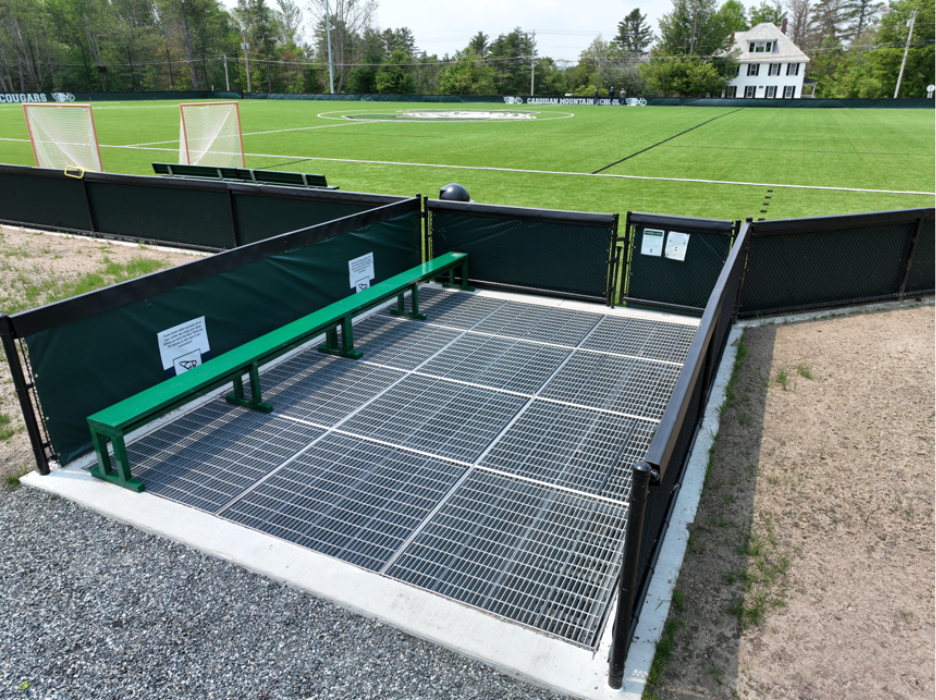
The technology was deployed and measured at fields in New Hampshire (Cardigan Mountain) and Denmark (Silkeborg). It demonstrated that with simple infrastructure upgrades such as gates, grates, fences, and designated entrance and exit areas, infill migration can be reduced to as low as 10 kilograms (22 pounds) per field per year. That represents a 98% reduction compared to original European Union estimates of microplastics from synthetic turf fields.
Even compared to the new EU REACH standards of 50kg (110 pounds) or less microplastic from fields, these results represent an 80% reduction.
That means that microplastics in the environment from infill can be dramatically reduced while maintaining the benefits of synthetic turf fields and recycled rubber infill.
Background & Results
Cardigan Mountain and Silkeborg demonstrated how to implement "Risk Management Measures" such as gates, grates, fences, and designated entrance and exit areas, as well as measure the dispersion of microplastics from infill.
These fields were subjected to rigorous testing over the course of two years, conducted by Firefly Sports Testing and the Danish Technological Institute. Researchers measured multiple potential pathways for infill migration, including over field perimeters, through players, by maintenance equipment, and via water drainage.
The results found that perimeter barriers around the field — including entrance and exit gates for players (with mesh grates and brushes to clean shoes), maintenance equipment grates, and drainage management — significantly reduced infill migration to as little as 10 kilograms a year.
Barrier height proved critical to effectiveness. For example, 60-centimeter (2 feet) barriers achieved substantially greater reduction than lower barriers, particularly in summer conditions. In fact, when these technologies are put into place, most infill leaves the field via players’ shoes and is stuck to clothing, where it is normally disposed of in residential garbage. The infill transported by players and disposed of in homes or changing areas is unlikely to enter the natural environment.
The effectiveness of these technologies has gained international recognition. In a significant policy decision, the United Kingdom recently chose not to ban recycled rubber infill, instead opting for containment measures that can reduce microplastic emissions by more than 90%.
Real-World Applications & Implications
One of the most important aspects of this breakthrough is that these containment technologies are available today as off-the-shelf solutions and do not need to be deployed universally.
The measures should be targeted specifically at fields where infill migration poses genuine environmental risk based on site-specific conditions. This is particularly important in areas near waterways, with significant snow removal operations, or in environmentally sensitive locations. This targeted approach ensures that resources are used efficiently while maximizing environmental protection.
Fields in urban areas with proper drainage systems. and not adjacent to natural environments, may require fewer or less intensive containment measures. Critical to success is training among maintenance staff, especially regarding snow removal practices — improper snow pile placement near field barriers can significantly increase infill migration.
Proven Recycled Rubber Infill Benefits
While addressing environmental concerns, it's essential to remember why recycled rubber infill became the preferred choice for synthetic turf systems. Recycled rubber provides superior performance characteristics that directly benefit player safety and athletic performance:
The breakthrough achieved through systematic testing at Cardigan Mountain and Silkeborg demonstrates that the synthetic turf industry can successfully address microplastic pollution concerns through innovative, deployable technology. With total emissions reduced to well below EU standards, these containment measures represent a triumph of engineering and environmental responsibility.
These technologies prove that blanket bans are unnecessary when smart, targeted solutions can achieve the same environmental goals while preserving the significant benefits that synthetic turf and recycled rubber infill provides to communities worldwide. The industry's commitment to continuous improvement and environmental stewardship ensures that synthetic turf will continue to serve communities while protecting the environment for generations to come.
###
Additional Resources
The following resources provide deeper context on the containment technologies and player behavior practices described in this report.
European Containment Standard — CEN/TR 17519
The foundation for this work is a formal European standard published in 2020: CEN/TR 17519, "Surfaces for sports areas – Synthetic turf sports facilities – Guidance on how to minimize infill dispersion into the environment." Developed by CEN Technical Committee 217 ("Surfaces for Sports Areas"), it describes best-practice options for keeping infill material within the confines of a field and is intended as a practical guide for field designers, venue owners, installers, and maintenance teams. The current edition is available through DIN (the German standards body):
DIN CEN/TR 17519:2024-03 — DIN Media
Silkeborgbanen — The Artificial Turf Pitch of the Future
The Silkeborg project is the most comprehensive real-world demonstration of CEN/TR 17519 in action. Initiated in November 2021 by Silkeborg Municipality and the Danish Football Association (DBU), the facility at Søholt Sports Facility was designed from the ground up to verify whether the CEN recommendations can keep microplastic dispersion below the EU benchmark of 7 g/m²/year (roughly 50 kg per full-size pitch per year). Two years of rigorous measurement — including multiple pathways for infill migration — produced the 10 kg/year result highlighted in this report. Updated results through 2025 are available on the project's dedicated website:
Silkeborgbanen — The Artificial Turf Pitch of the Future
Visual Guide to Containment Measures (ESTC)
The European Synthetic Turf Organisation (ESTC) has published an illustrated overview of the physical Risk Management Measures (RMMs) used to contain infill — including perimeter barriers, entry/exit gates with brushes and grates, and drainage management. This is a useful visual companion to the technical standard:
Risk Management Measures — Illustrated Guide (PDF)
Player Behavior Poster (Danish Football Union — DBU)
A practical, field-ready poster produced by the DBU illustrating the simple behaviors players and coaches can adopt to reduce infill they carry off the field — shoe brushing, designated exit routes, and changing room practices. Suitable for posting at field entrances and in changing facilities:
Player Behavior at Artificial Turf Pitches — DBU Poster (PDF)


